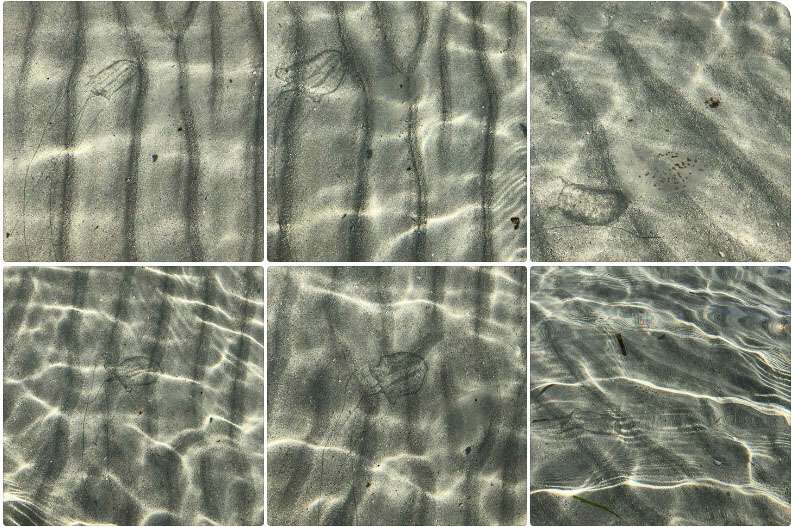
The jellyfish in question, photographed last Sunday at Islet Ténia. The author of the pictures says “that there were many in the water and dozens stranded still alive. They are invisible in the water or almost, we see them thanks to their shade, the filaments are 100% invisible “. Chris CH Pictures
These are jellyfish that can cause severe to very severe envenomation. Captures of these jellyfish are ongoing, for precise identification purposes. At this point, it appears to be “Irukandji” jellyfish, the Cubozoa class, commonly referred to as “cubo jellyfish” because of their box shape.
Testimonies of bathers also bitten have reported these jellyfish in a maritime geographical zone from the lagoon of Bourail to that of the island Amédée.
As a result, the DASS reiterates its recommendations:
– Do not bathe in the indicated areas.
– Do not handle a jellyfish, even stranded or dead.
In case of sting :
– Get out of the water as soon as possible.
– Thoroughly rinse with vinegar as soon as possible the wound and the tentacles (if there are any) to inactivate the venom.
– After applying the vinegar, remove the tentacles gently, using tweezers, and not with bare hands.
– Dry and warm up the person quickly.
– Take a pain treatment if necessary.
– Request medical advice urgently, or call 15.
Warning :
– Never rinse lesions or tentacles with seawater, fresh water, urine, lemon, alcohol, soda, shaving foam, etc.
– Do not scratch the tentacles (the tension of the tentacles can cause a discharge of venom).
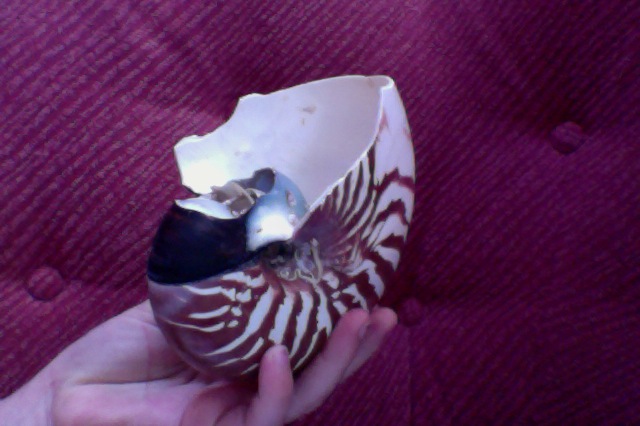
On Friday Dad and I went for a walk along the beach and had a surprise waiting for us. Two Nautilus shells!
We took them back to the boat and showed them to Mum.
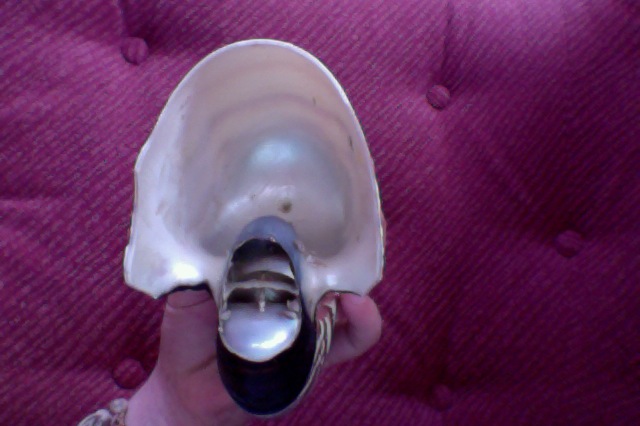
These are photos of one of the the shells.
Nautiluses are animals that have been here for over 500,000,000 (five hundred million) years, a long time before humans arrived, which was 1,500,000 (one million and five hundred thousand) years ago. Unlike humans and other living organisms, they haven’t changed or evolved since they arrived.
The word “nautilus” comes from the Latin form of Ancient Greek word “vaut”.
Nautiluses are molluscs from the cephalopod family, Nautilidae.
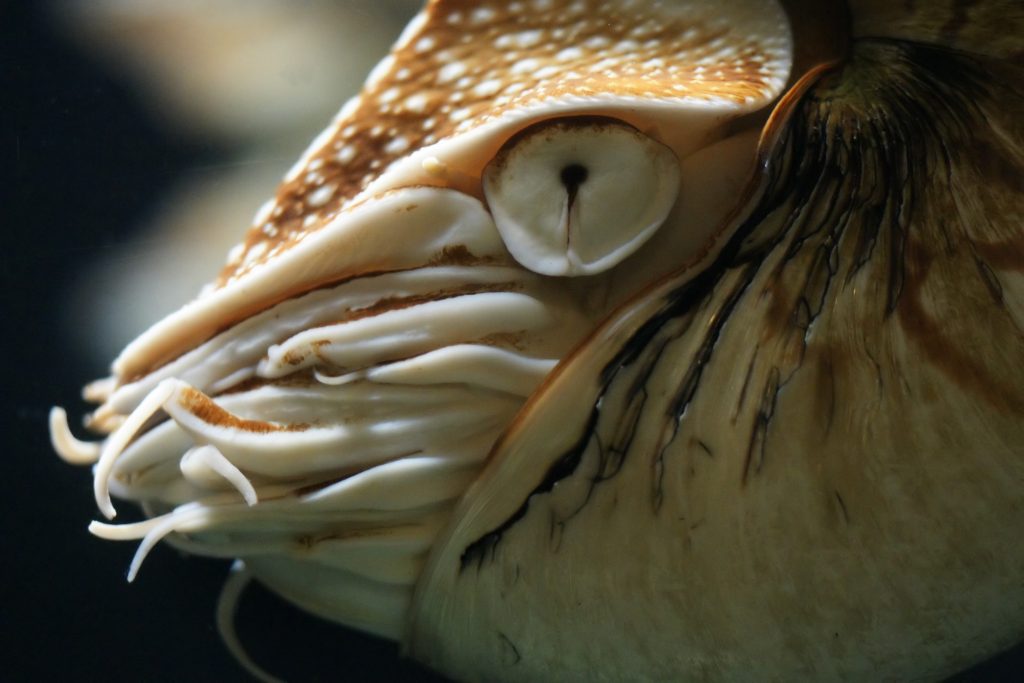
They have a parrot like beak for ripping apart crustaceans. Nautiluses have blue blood, when it is oxygenated, unlike ours, which is red because of our haemoglobin cells.
They have a large shell which has a hole the shape of a bucket were the body and head of the Nautilus is kept. The actual shell is lined with mother-of-pearl (oyster) and is pressure resistant up to 800 meters below sea level!
Did you know that nautilus’s have eyes? Weird right? They use them to see if a predator is coming and how well their camouflage is working.
Four years ago I’d never been on a sailboat. In all honesty I thought sailing was for rich people who wore bad clothing. My childhood memories of the America’s Cup and Dennis Conner didn’t help either. In a few days we are sailing from New Zealand to New Caledonia in our boat. Most people I know think we’re nuts for doing this but I’m feeling excited and confident. I can’t wait to go. This is how I went from knowing nothing about sailing to taking our own boat offshore.
Robin had sailed dinghies as a teenager and he was keen to sail again. He did the Wellington Learn to Sail course and I hoped he’d get it out of his system. He didn’t, and instead he talked me into a holiday in the Bay of Islands where there is a fantastic sailing school who also charter boats – you are taught to sail, then given the boat to sail by yourselves. Before we went I didn’t expect that after the three instruction days we would actually sail the boat alone, instead I was secretly plotting to get off the boat and to the Duke of Marlborough. I was still hopeful that if I went along with Robin’s sailing interest he would get over it.
So in October 2014, Ian, our instructor, spent three days taking me from someone who didn’t know how to get onto a boat, to someone who could confidently head off into the bay with only Robin for help – after those three days of instruction we could find our way around the islands, anchor overnight, and avoid the rocks. Looking back I’m amazed at Ian’s patience. I didn’t see him wince once. No eye rolls either.
We went back to Great Escape, the sailing school/charter company, in February 2015 and chartered one of their Raven 31 boats (no instruction this time!) . Iris loved it, I could see she was totally at home on a boat. It was a great family time, lots of jumping into the sea. I was starting to warm up to this.
In January 2016 we bought Sojournie, a Lotus 9.2, in Nelson. We made lots of mistakes but none of them seemed to end in complete disaster. We sailed her in the Marlborough Sounds and over the Cook Strait a few times. I couldn’t believe how deserted a lot of the bays in the sounds were – we were often alone in paradise and I didn’t know why more people aren’t out there on boats. Money is the obvious issue but Sojournie cost less than a new family-sized car (let’s not discuss the maintenance budget). I’m good with driving an older car so we can afford a boat but I know we’re lucky and that financially a lot of people can’t afford a boat or a new car.
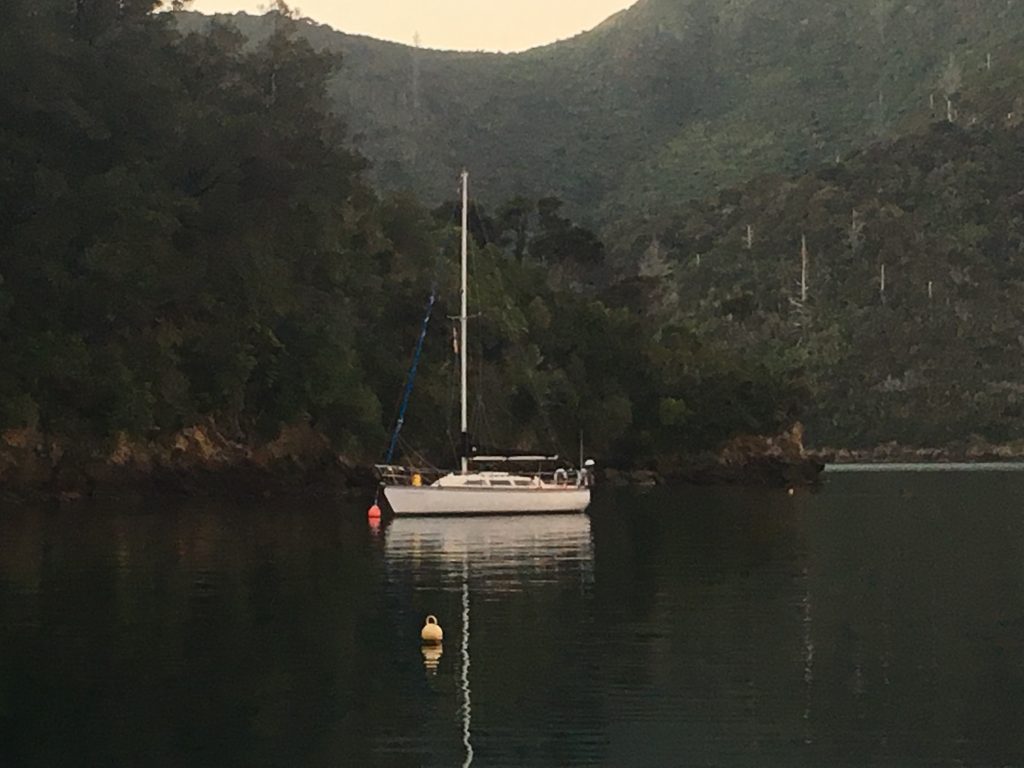
Sojournie in the sounds
That year we started talking seriously about buying a bigger boat that was capable going offshore. There were lots of reasons for this – Robin had always had the desire to do it, Iris was a good age for it (not a teenager yet but old enough to be sensible), I was getting pretty burnt out as a midwife (best job in the world but I found the 24/7 oncall was too hard to sustain). I like to think Robin got me in a weak moment but in truth I was ready to commit to doing something adventurous. I liked how mad it seemed.
In November 2016 we sold Sojournie, mortgaged the hell out of the house, and bought Impulse II (we changed the name to Dog Star), another Alan Wright design but this time 42 feet and designed to be capable of sailing an ocean. It’s a very safe and well built boat but most importantly it has a *hot shower*.
Although we’d been sailing for a few years, before we went offshore we wanted to get more skills, so last year Robin and I did the RYA Coastal Skipper course at Sail Nelson. Iris came with us and she did her Level 1, Competent Crew. I was really proud of how well she went on this course and how good our instructor was with a child. She knows more knots that I do now. I really benefited from the boat handling part of this course. Prior to this I’d been struggling with berthing the boat (read: I was terrified of it, avoided doing it at all costs and yelled a lot when doing it) and after this course I became the person who usually berths our boat. I feel quite pleased with myself when I do it, but I’m still relieved when (if) we don’t hit anything. It’s very easy for me to to sit back and let Robin do the things that seem out of my comfort zone – some of these skills are intimidating – and it’s been important to me not to do this (too much).
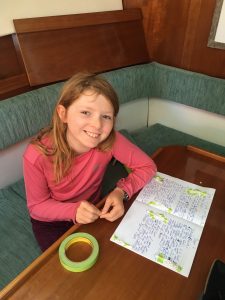
Iris making knots and pasting them into her journal with explanations on how to make them and when to use them
We also wanted some experience sailing offshore. Kim, a boatbuilder who had surveyed Dog Star before we bought her, was delivering a 54ft Moody to/from Noumea and was generous enough to take us as crew – Robin went in May, Auckland-Noumea, and I went in September, Noumea-Auckland. Kim and Craig, the other crew member, have been sailing many years and have both done the Sydney-Hobart race. I knew I was in good hands and I felt relaxed enough to spend the passage focused on the task at hand (talking Kim into shaving off his moustache). In all honesty it was an unusually calm passage and may have lulled me into a false sense of security about the ease of offshore passages. I’m still holding onto the idea that getting out of Wellington harbour is supposed to be the hardest part.
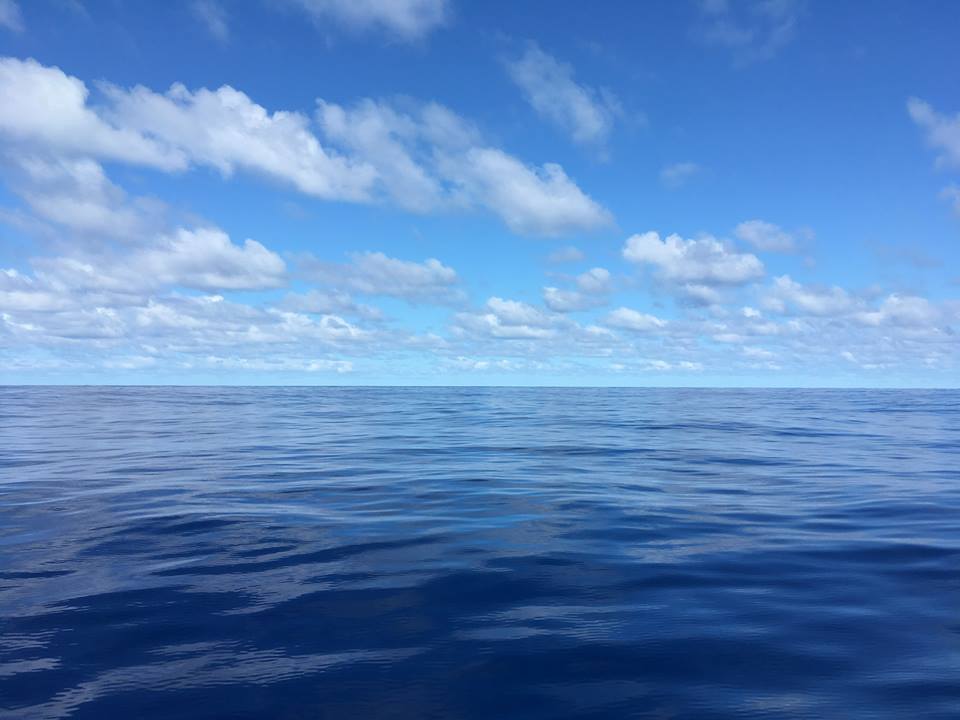
Calm conditions Noumea-Auckland
A lot of last year and the first few months of this year were spent working on Dog Star. We’ve been lucky to have people like Kim, the boatbuilder, and Travis, diesel engineer, to help us, as well as Craig to give us advice and encouragement and generally be enthusiastic about the whole idea of going offshore. The boat maintenance was another area I found intimidating, and although my knowledge and skill level is nowhere near Robin’s and I don’t know what anything is called, I get into the engine bay and go up the mast.
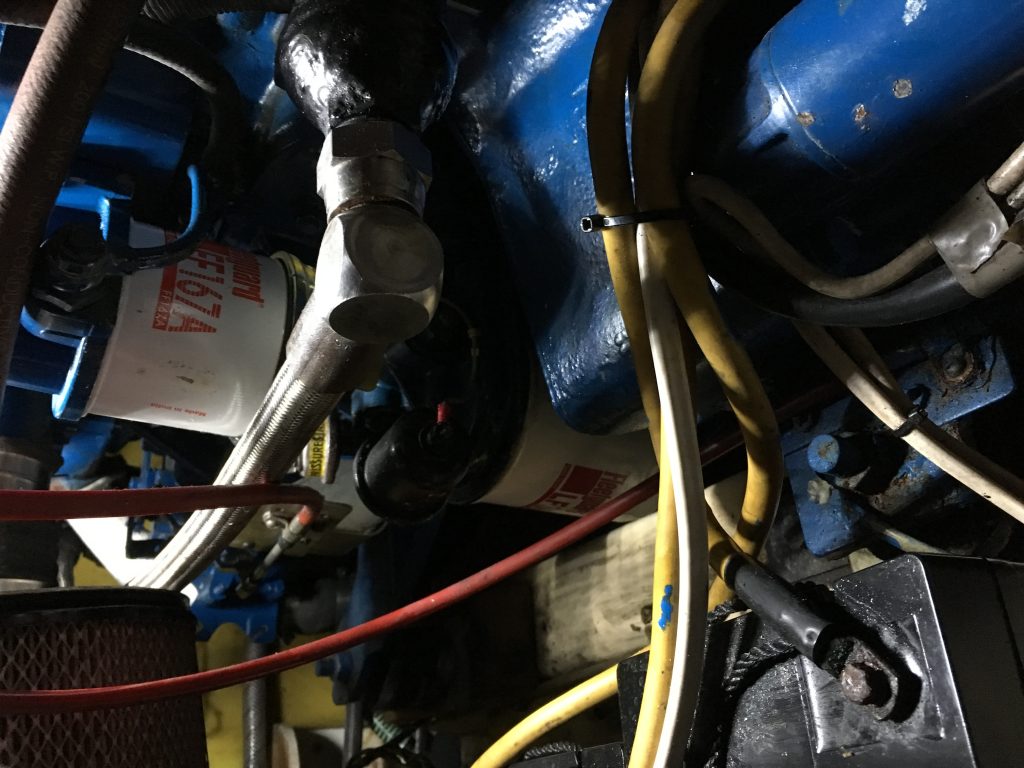
The blue whatsit diesel thingy
In truth, the hardest part of all this wasn’t learning to sail but figuring out how to leave our life in Carterton – saying goodbye to family and friends, renting out our house, helping at the last birth. We’re going to get so much good family time together that I think it’s all worth it. So in less than four years, it’s all happening!
Last night, at seven o’clock, we went to a talk. Lisa Blair was talking.
Lisa Blair was the first woman to sail solo around Antarctica.
On her way round, she was demasted and had a collision with a container ship that was trying to give her fuel, but instead was bashing up her hull.
It was an extremely exciting and interesting talk and showed all the people in the room just how hard it can be.
She is also doing a talk in Auckland tonight, so if you are free, head up and enjoy. I seriously
recommend it!
Not very much is happening here. We are still stuck in Opua, though a few nights ago, we did go to Russell which was fun!
I hope that everyone is enjoying themselves!
Yesterday we went to Waitangi, where the treaty of Waitangi was signed. When we were there, we learnt about the history of the treaty.
Apparently, there were two versions of the treaty, one in English and one in Maori. The Maori version said that the people from the United Kingdom coming to settle in New Zealand would act under ‘governor ship’, while the English version said that they would act under ‘sovereignty’. Governorship means that the English help with the community but not control it. Sovereignty means that the English would control New Zealand, the community and the indigenous (Maori). Major differences! There were any protests and a big scandal.
For more detailed information, visit https://en.wikipedia.org/wiki/Treaty_of_Waitangi .
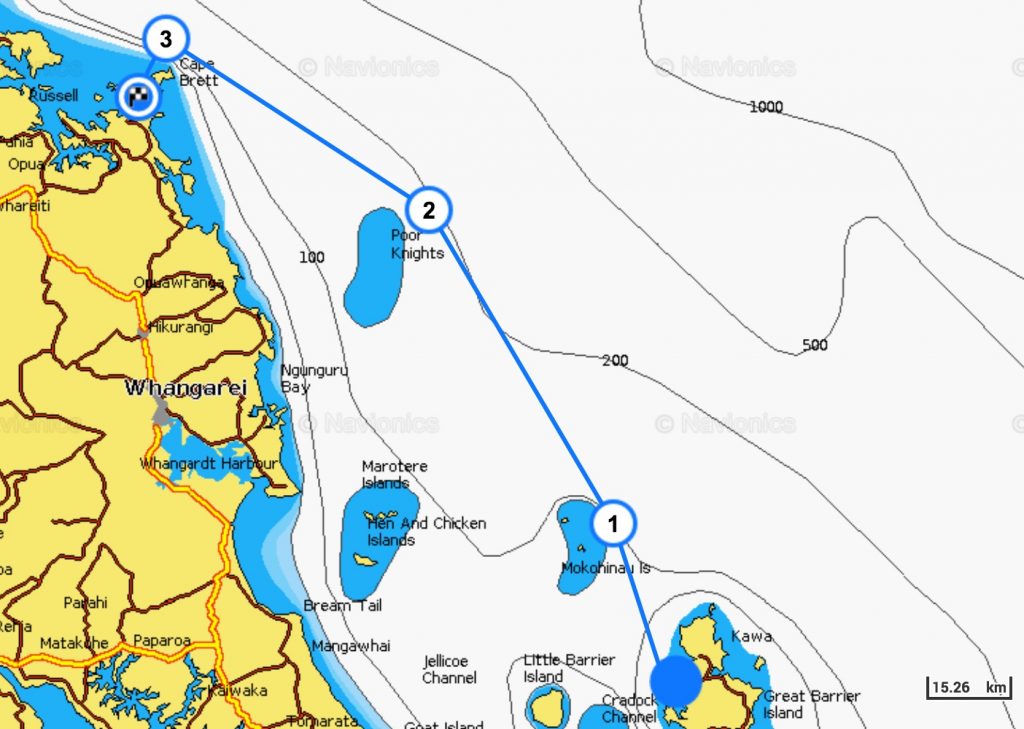
After a few days of exploring Port Fitzroy on Great Barrier Island, we thought it was a good time to make passage to the Bay of Islands, our last NZ stop before our offshore passage to Noumea. The sail was likely to take us 14 hours so instead of leaving in the dark and arriving in the dark, we decided to make passage overnight, leaving and arriving in daylight, but best of all, allowing us a night sail.
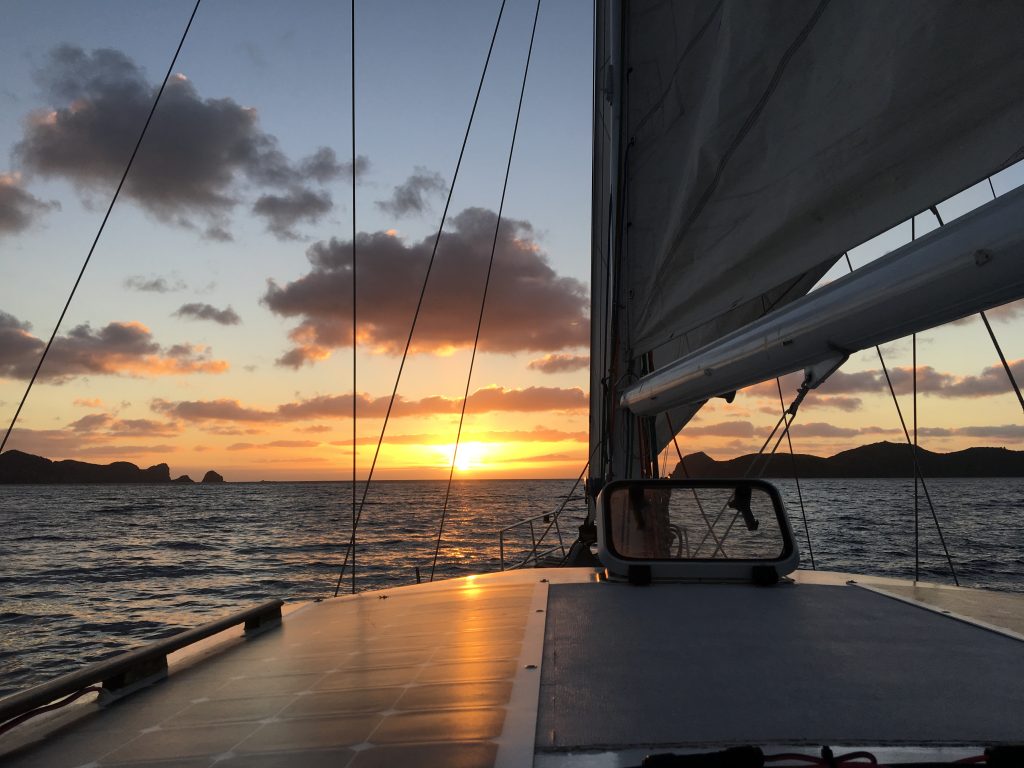
Sailing into the sunset out of Port Fitzroy, Great Barrier Island
Sailing at night is my favourite type of sailing, this particular night was an ideal sailing night. We had good winds, 20kn with gusts of 25kn, we put in a reef (reduced the sail size to make the boat easier to handle) and headed out into the open sea, sailing a course around the outside of the outlying islands off the coast of NZ to keep things easy.
Route to the Bay of Islands
With the clear sky, you can steer to the stars, we turn off all the unneeded systems, the engine, the autopilot, the bright chartplotter and the sky becomes alight with stars. Before the moon rise (midnight tonight), stars are the only light. At the wheel you can pick a star, line it up with some rigging or other part of the boat and keep steering a straight course, for a while at least. Tonight was a good planet night – Jupiter was my lead for a while, and as Jupiter rolled across the sky, a new star was needed, a bright star that was in the right spot was Sirius, the Dog Star (fitting eh?). As Sirius wheeled away, Castor and Pollux, the twin brothers lead the way. Each time a new star came a long, I’d quickly check Star Walk on my phone to see what I was steering to, and maybe even take a quick look at the stories behind them.
I’m not unique when I say this is a time when I feel connected to nature and the universe as a whole, I’ve read it before in books and blogs written by many others. It is true though: the boat, the wind, the stars, the sea and you, come together in motion. It’s hard also, not to feel aware of the thousands of years that humans have done this before me, and that somehow it’s in our DNA to do it, it feels instinctual.
The other part of night sailing that I love is the shooting stars, if you are constantly looking at the sky, the number of shooting stars is astounding. It feels like only minutes pass between each of them, although time does get a bit weird when sailing at night. This night I was treated to a very low shooting star that crackled crisply as it burned up across the atmosphere.
The stars also spread into the sea, the planets cast a coloured reflection across the water, but the tiny bioluminescent sea creatures glow blue and green in the disturbed water around the boat.
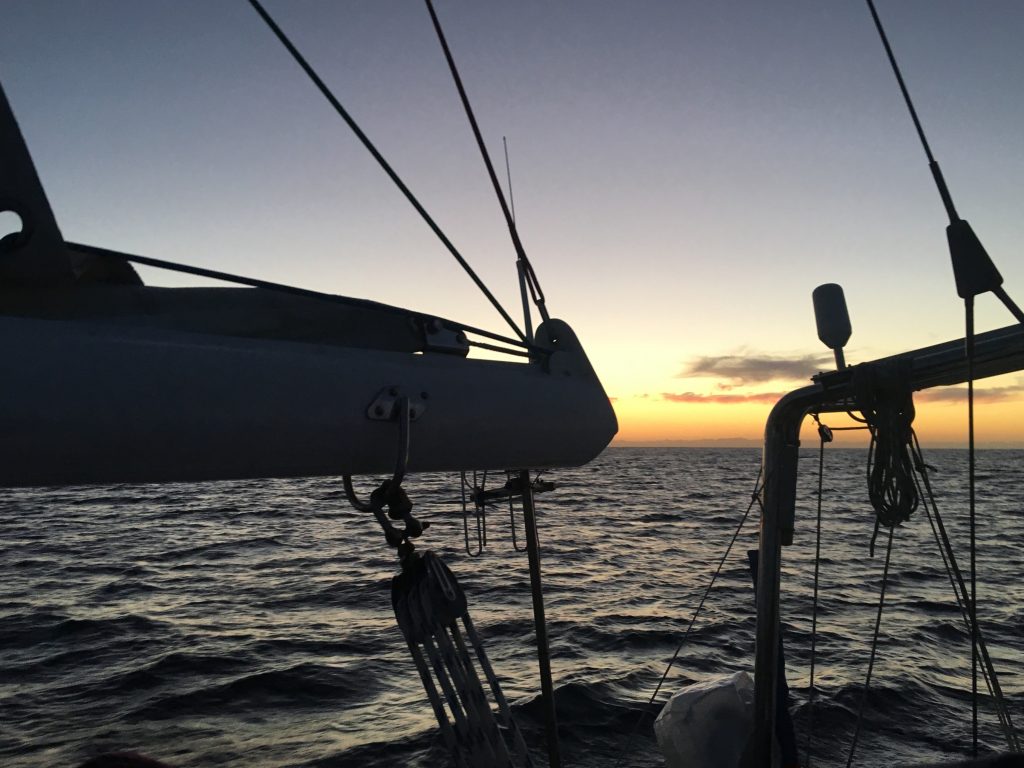
Sunrise off Cape Brett
I enjoyed this night sail so much that I stayed on watch most of the night, but as I was feeling more and more tired, I needed a hand, so I woke Clare to join me and watch the sunrise. It’s much colder on the water than on land, and the sun coming up over the horizon is amazing as it brings light and warmth and it feels so good.
“I must go down to the seas again, to the lonely sea and the sky, And all I ask is a tall ship and a star to steer her by, And the wheel’s kick and the wind’s song and the white sail’s shaking, And a gray mist on the sea’s face, and a gray dawn breaking.” ― John Masefield
Happy Mothers Day!
At the moment, we are in Opua and I have just finished doing the washing.
It is raining off and on and it is very hard to just relax and have a nice, sunny day.
The visitors facilities revery expensive and we might run out of cash soon.
I hope that everybody is having a good mothers day!
Next week Brian is going come to Opua and we are boing to sail to New Caledonia! I promise I will update from there.
Today we went on a march to protest midwifes getting paid better and to change their work conditions. It was really awesome and as we walked we carried balloons and signs like “In a world of Davids, be a Helen”. As we walked up we chanted and shouted. It was so cool. Afterwards we went for brunch and I gave my balloons to this cute red headed baby.
We are going to sail to Great Barrier Island soon and I promise I will update soon.
Sailing out of Wellington Harbour on Friday the 13th (yes, I know) brought on a mixture of feelings, excitement, apprehension, anxiety, freedom – but the inevitable sensation of leaving without all the jobs done, so many were, but the culmination of renting out the house, moving onboard, preparing the boat, leaving the business was a messy and awkward peak to crest. A million questions roared around in my mind about the boat and whether all those jobs I’d done were done well enough. A moment to calm my mind and think about what counts, holes below the waterline don’t leak, the sails work, the rig is new…. the rest is really just for comfort. Craig was there to cast off our lines with a friendly smile and encouraging words, which was a great way to start the journey. Iris played her guitar as we passed the white lady for the last time for probably a year if not more.
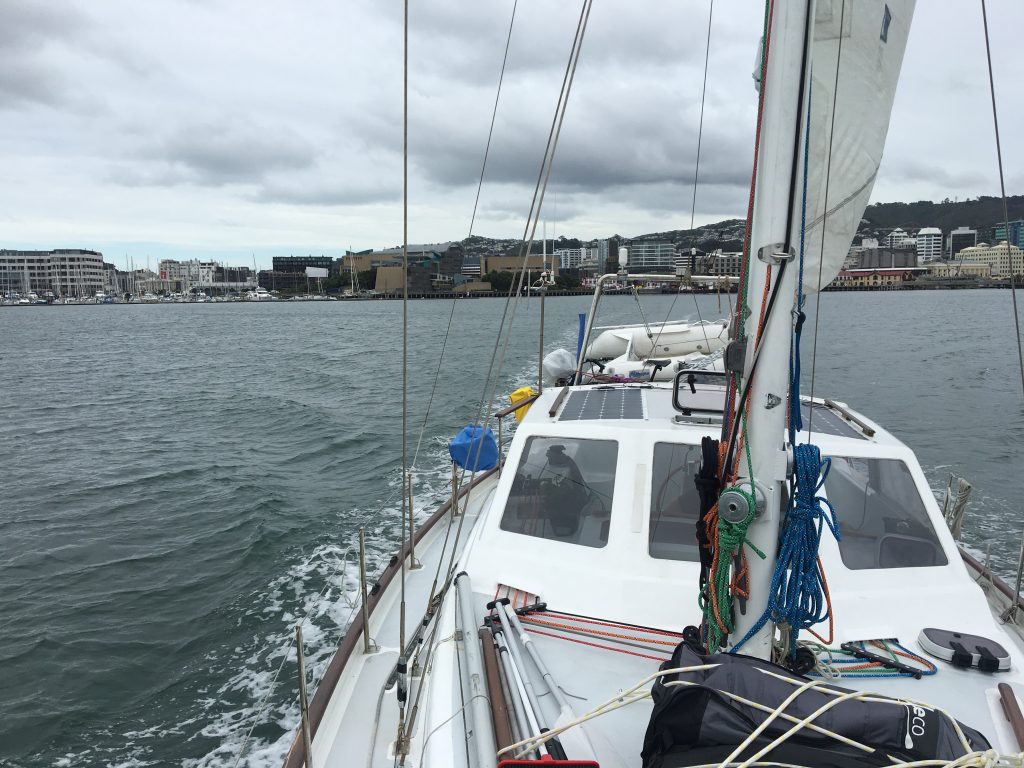
Sailing out of Wellington
Heading across Palliser Bay, the big swell from the previous week’s storm was right on our beam, mixed with sloppy seas and no wind, we rolled and bucked while waves slapped our topsides. The water rushing up the bilge pump drain found it’s way into the cockpit drain, filling the cockpit floor with stinky bilge water. This is actually a safety issue as the Cat 1 regulations don’t allow this, I thought I had sorted it, but there was clearly a hidden plumbing issue – my thoughts started rolling around in doubts and I began inspecting the plumbing in my mind. What is that sound? Is the engine sounding ok? I dashed down below to check the engine bay – all was looking good but the uncertainty was creeping up on me. I went back to the cockpit, but the smell of diesel and my unsettled nerves were too much and I experienced my first bout of seasickness….
It’s true what they say though, “just get it out” I had a little vomit and then everything suddenly seemed better. The feeling of impending doom lifted and as we rounded the Cape, we had the swell on our starboard quarter and the boat settled into a rhythm. A little wind picked up and we were motorsailing. An easy sail from there on in, although just after the sun set one evening Iris and I overheard the mayday call and coastguard response from the stricken yacht Erojca, holed off Whangara and about to be washed onto the beach. Why were they so close in? I explained to Iris why we sailed nearly 20nm off the coast and put a reef in before dark.
A couple of nights later we were pulling into Gisborne Marina, a big sleep and some of Clare’s cannelloni brought warmth and comfort.
The week in Gisborne was spent sorting out our errant plumbing, installing a better solar controller and a few other jobs on the boat that needed taken care of. We were lucky to arrive for the 90th birthday celebrations of Clare’s Aunt Catherine and Uncle Michael. All the cousins were there and it was fantastic to get to know them all better.
The plan from here was to sail to Mayor Island in the Bay of Plenty, this trip would be so much easier, but then it was always going to be.